 Built Blue Since 1940
EN Contact Us
Built Blue Since 1940 Explore our factory-engineered felt wheels, pads, and cylinder bobs. Manufactured from 100% premium virgin wool fiber with custom density, arbor dimensions, and bonded hub configurations designed for heavy-duty industrial polishing.
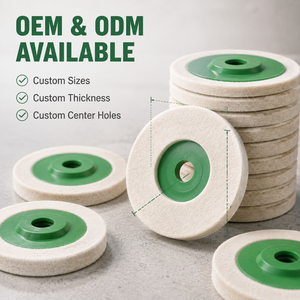
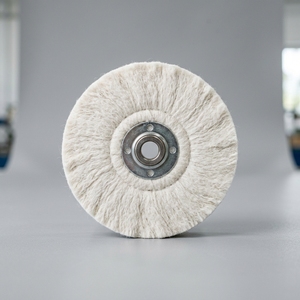
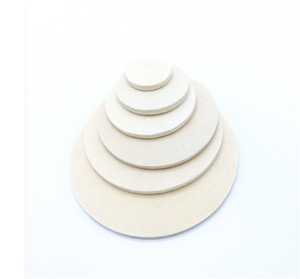
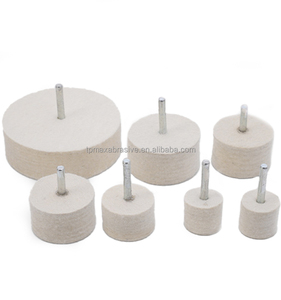
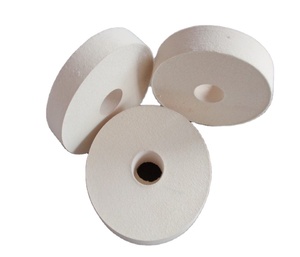
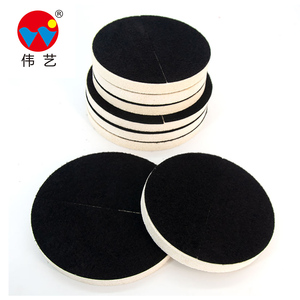
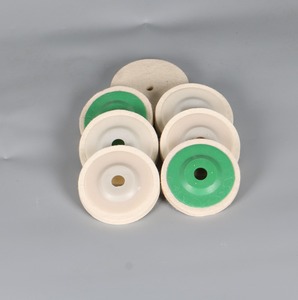
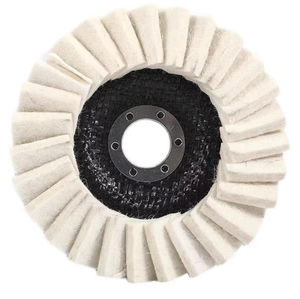
Understanding the mechanics of interlocking wool scales, fiber density control, and chemical binding matrices for optimum Ra surface finish efficiency.
Industrial wool felt is not woven; it is manufactured through a continuous thermo-mechanical pressing, fulling, and needle-punching process that interlocks pure wool fibers into a tight, three-dimensional matrix. Unlike synthetic foam or woven cotton discs, natural wool fibers feature microscopic directional scales (cuticles). When rotated against metallic, glass, or stone surfaces, these scales perform two crucial actions:
As a leading OEM/ODM felt wheel factory, our production lines precision-engineer wool density ranging from extra-soft (0.10 g/cm³) for delicate optical finishing up to rock-hard (0.90 g/cm³) for aggressive weld seam blending and heavy metallic deburring.
We partner directly with industrial tool distributors, automotive assembly suppliers, and specialized polishing equipment manufacturers worldwide to provide white-label and custom-engineered felt solutions.
Outer diameters from 10mm micro bobs up to 600mm heavy industrial wheels. Thickness custom-sliced from 3mm to 100mm.
Reinforced fiberglass backing, color-coded ABS hub injection molding, quick-change threaded arbors, and 1/4" steel shank shafts.
Custom artwork clamshells, barcoded hanging cards, polybags, bulk export cartons, and laser-etched branding directly on wheel hubs.
Selecting the correct density and hardness rating prevents premature wheel wear, work-hardening of alloy substrates, and edge rounding.
| Felt Grade / Density | Hardness Rating | Shore Hardness | Recommended Operating RPM | Primary Industrial Application | Abrasive Compatibility |
|---|---|---|---|---|---|
| Soft (0.18 - 0.22 g/cm³) | Soft / Flexible | Shore A 20 - 35 | 1,200 - 2,500 RPM | Automotive clear coat finishing, final polish on curved brass, wood lacquer buffing. | Fine Liquid Wax, Light Glaze |
| Medium (0.34 - 0.44 g/cm³) | Medium Standard | Shore A 40 - 55 | 2,500 - 4,500 RPM | General metal polishing, stainless steel cookware, medical implant pre-polishing. | White Rouge, Green Chromium Oxide |
| Hard (0.50 - 0.65 g/cm³) | Industrial Hard | Shore A 60 - 75 | 4,500 - 7,500 RPM | Flat glass beveling, stone edge polishing, cutlery blade mirror finishing, aircraft parts. | Cerium Oxide Slurry, Aluminum Oxide |
| Rock Hard (0.70 - 0.90 g/cm³) | Rock Hard / High-Density | Shore A 80 - 95 | 7,500 - 12,000 RPM | Metallographic sample preparation, heavy deburring, watchcase corner beveling, glass scratch repair. | Diamond Compound Paste (1µm - 15µm) |
As global manufacturing shifts toward high-precision automation, green sustainability compliance, and robotic polishing cells, felt wheel procurement standards are rapidly evolving.
Robotic polishing cells demand extreme dimensional tolerances (+/-0.1mm) and strict dynamic balance verification. Out-of-round or unevenly weighted felt wheels introduce harmonic vibration, causing chatter marks on aerospace and automotive components. Future OEM buyers require pre-balanced wheels with zero run-out guarantees.
While pure virgin wool remains the premium standard for heat dissipation, hybrid felt formulations combining recycled synthetic microfibers with natural wool are gaining traction in cost-sensitive industrial sectors. These hybrids provide increased tensile tear resistance at lower unit costs for heavy-duty metal foundry deburring.
Global procurement teams in the EU and North America now demand REACH, RoHS, and formaldehyde-free chemical binder compliance. Modern felt wheel factories are replacing traditional phenolic resins with water-based eco-binding agents that emit zero toxic VOCs during high-speed thermal friction polishing.
Engineered to professional trades standards since 1940. Our factory combines heritage manufacturing discipline with automated optical quality control to deliver consistent surface finishing tools worldwide.
Procurement teams need more than product photographs; they require traceable specification data, consistent lot-to-lot wool density, and secure global supply chain logistics.
Common questions answered by our chief metallurgical polishing engineers and global export sales directors.
For stainless steel mirror polishing (achieving Ra < 0.05 µm), a two-step process using Hard Density felt (0.50 - 0.60 g/cm³) followed by a Medium-Soft felt wheel (0.35 g/cm³) is recommended. The hard wheel paired with green chromium oxide compound removes micro-scratches from previous sanding steps, while the medium-soft wheel loaded with fine white aluminum oxide slurry delivers the final haze-free mirror reflection.
100% natural wool felt offers vastly superior thermal dissipation compared to synthetic polyester or nylon wheels. Wool fibers naturally absorb and release friction heat while retaining polishing compounds inside their spring-like cellular structure. Synthetic fibers tend to soften, smear, or glaze over at high surface speeds (above 3,000 RPM), leaving burnt resin residues on heat-sensitive alloys and optical glass.
Our OEM/ODM capabilities encompass custom outer diameters (10mm to 600mm), specialized arbor bore sizes (e.g., 22.23mm, 16mm, 6mm shanks), custom wool color dyes (white, natural grey, industrial green), density adjustments from 0.10 to 0.90 g/cm³, laser-printed branding on hubs, customized retail blister packaging, and private label master carton designs.
For standard catalog sizes (such as 100mm/125mm angle grinder felt discs), our factory MOQ starts at 500 units per specification. For custom-molded cylinders, micro-bobs with shanks, or proprietary fiber blends, standard MOQs range between 1,000 and 3,000 units depending on raw material tooling requirements. Sample prototyping is available for qualified commercial buyers prior to mass production.
Industrial wool felt wheels should be stored flat in a dry, temperature-controlled environment (relative humidity below 60%) to prevent moisture absorption and fiber expansion. Keep wheels sealed in dust-proof polybags when not in use to prevent atmospheric grit accumulation, which can contaminate the wheel and cause random scratches during delicate surface polishing.
Whether you require standard bulk supply, private-label packaging for your distributor channel, or custom-engineered wool density for automated production lines, our engineering team is ready to assist.