85+
Years of precision manufacturing excellence (Built Blue since 1940)
 Built Blue Since 1940
Years of precision manufacturing excellence (Built Blue since 1940)
Optical profile & Rockwell hardness quality control
Active tooling SKUs optimized for global distribution
Maximum red-hardness retention across premium cobalt lines
In automated manufacturing, CNC metalworking, and structural steel erection, tool failure equates directly to costly downtime. Choosing the correct specification of High-Speed Steel (HSS) twist drills requires a deep understanding of alloy chemistry, thermal tolerance, web thinning, and point geometries.
High-Speed Steel (HSS) transformed industrial manufacturing by retaining hardness at elevated operating temperatures created by friction. However, modern alloy steels, stainless grades (304, 316, 17-4PH), and high-temp aerospace materials require specific carbide-forming elements to maintain edge sharpness under severe shear stress.
M2 Standard High-Speed Steel (W6Mo5Cr4V2): M2 represents the universal industry standard for general metalworking drill bits. Formulated with a balanced mixture of tungsten, molybdenum, chromium, and vanadium, M2 delivers exceptional toughness, abrasion resistance, and a working hardness between 63 and 65 HRC. M2 drill bits are ideal for mild steels, low-alloy steels, copper, aluminum alloys, and dense woods.
M35 5% Cobalt High-Speed Steel (HSS-Co5): By adding 5% cobalt to the M2 matrix, M35 steel significantly raises the hot-hardness threshold (red hardness) up to 600°C. Cobalt increases the melting temperature of the alloy matrix, preventing the thermal degradation of the cutting lip when drilling work-hardening materials like austenitic stainless steel and structural steel plate. Expect a hardness range of 65 to 67 HRC.
M42 8% Cobalt High-Speed Steel (HSS-Co8): Designed for ultra-demanding machining centers, M42 contains 8% cobalt and achieves a hardness rating of 66 to 68 HRC. M42 bits provide superior fatigue resistance and thermal stability when cutting high-tensile titanium alloys, Inconel, hardened tool steels, and abrasive composite materials.
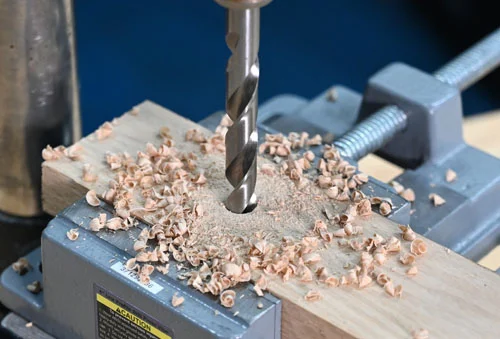
Specifying a 5% or 8% Cobalt bit (M35/M42) for soft aluminum or mild structural tubing often increases per-unit tool cost without delivering proportional tool-life benefits. Conversely, utilizing basic M2 bright-finish bits on 316 stainless steel leads to rapid work-hardening, thermal binding, and immediate tip failure. Century Drill & Tool assists procurement teams in mapping drill bit SKUs directly to workpiece tensile strength, maximizing ROI across high-volume production lines.
Beyond material composition, the mechanical design of the drill bit tip dictates chip ejection efficiency, axial thrust requirement, and hole roundness consistency.
Use this verified technical reference matrix to match material specs, recommended surface treatments, speeds (SFM), and geometric parameters for global purchasing requisitions.
| Workpiece Material | Recommended HSS Grade | Point Geometry | Optimal Coating | Speed (SFM) & Feed Strategy |
|---|---|---|---|---|
| Mild / Low Carbon Steel (1018, 1020) | M2 High Speed Steel | 118° Standard / 135° Split | Black Oxide / TiN | 90–110 SFM; Moderate continuous feed; flood coolant recommended. |
| Medium / High Carbon Steel (1045, 4140) | M2 / M35 Cobalt | 135° Split Point | TiN / TiAlN | 60–80 SFM; Firm steady pressure; water-soluble cutting fluid. |
| Austenitic Stainless Steel (304, 316) | M35 (5% Co) / M42 (8% Co) | 135° Split Point (Heavy Web) | Straw Bronze / TiAlN | 40–50 SFM; Heavy constant feed rate; NEVER allow bit to dwell. |
| Tool Steel & Die Alloys (D2, P20) | M42 (8% Cobalt) | 135° Heavy Duty Split | TiAlN Coated | 30–40 SFM; High torque, low RPM; synthetic cutting oil. |
| Non-Ferrous Aluminum & Brass | M2 High Speed Steel | 118° Polished Flute | Bright / Uncoated | 200–300 SFM; High RPM, light feed; mist coolant to prevent chip welding. |
| Abrasive Cast Iron & Ductile Iron | M2 / M35 Cobalt | 118° / 135° Split Point | Black Oxide / TiAlN | 70–90 SFM; Dry drilling or air-blast; chip extraction critical. |
Built for professional trades, OEM automotive assemblies, structural fabricators, and high-volume industrial supply distributors worldwide.
ANSI standard straight shank twist drills with 135° split point and durable black oxide finish for high-volume metal drilling.
SKU Series: 11000
5% Cobalt HSS alloy built specifically to handle work-hardening stainless steel, tough nickel alloys, and high-tensile welds.
SKU Series: 13000
Single-pass center drilling and 60° countersinking for precision lathe tailstock centers and metal fixture production.
SKU Series: 25000
Reverse-flute high-speed steel drills paired with tapered screw extractors to back out seized fasteners without damaging thread walls.
SKU Series: 73000Analyzing key shifts in AI-driven machining, raw material volatility, surface coating innovations, and ESG compliance shaping the global high-speed steel tooling market.
As automotive, defense, and aerospace manufacturers shift toward lightweight, ultra-high-strength materials (duplex stainless steels, titanium aluminides, carbon composites), standard carbon-steel and lower-grade HSS cutting tools are rapidly becoming obsolete. Procurement intent data indicates a massive demand increase for M35, M42, and Powder Metallurgy (PM HSS) cutting tools.
Powder metallurgy HSS eliminates carbide segregation during forging, creating a micro-grain structural uniformity that doubles tool toughness without sacrificing red-hardness. Smart procurement officers are locking in long-term supply contracts for high-cobalt and PM grade lines to maintain high automated spindle utilization rates.
While traditional Black Oxide and single-layer Titanium Nitride (TiN) remain staple finishes for budget metalworking, advanced automated factories demand physical vapor deposition (PVD) nanocomposite coatings such as TiAlN (Titanium Aluminum Nitride) and AlCrN (Aluminum Chromium Nitride).
These ultra-thin coatings exhibit thermal oxidation stability exceeding 900°C, transforming the micro-surface of HSS drill bits into highly friction-resistant barriers. This advancement enables dry high-speed drilling, reducing cutting fluid consumption by up to 40% and helping industrial buyers fulfill corporate ESG (Environmental, Social, and Governance) sustainability mandates.
Modern CNC machining centers increasingly integrate AI-based vibrational and torque load monitoring systems. High-precision HSS drill bits must adhere to strict shank diameter tolerances (h8/h7 tolerance class) and minimal total indicator reading (TIR) runout under 0.0005 inches.
Variance in bit concentricity triggers premature machine emergency stops or chip-breaking spikes. B2B suppliers must now provide full optical inspection documentation and batch-level heat treatment certificates to satisfy digital supply chain integrations.
With tungsten, molybdenum, and cobalt classified as critical strategic metals, global distributors are partnering with tool manufacturers who operate closed-loop recycling programs. Century Drill & Tool leads this initiative by utilizing recycled scrap high-speed steel in specialized electric arc furnace (EAF) smelting processes, decreasing carbon intensity per unit produced without compromising micro-hardness performance.
Founded in 1940, Century Drill & Tool has built an enduring legacy of manufacturing integrity, field-tested engineering, and unmatched distribution support under our hallmark "Built Blue" commitment.
Answers to key technical questions sourced from global procurement managers, CNC programmers, and AI purchasing queries.
M2 High-Speed Steel is the standard industrial grade for general metalworking, offering excellent toughness and balanced wear resistance for mild steel, aluminum, and wood up to 63-65 HRC. M35 Cobalt alloy contains 5% cobalt, raising thermal resistance up to 600°C (HRC 65-67) to prevent tip deformation when drilling stainless steel and structural alloys. M42 Cobalt alloy contains 8% cobalt, reaching 66-68 HRC, designed specifically for heavy-duty production drilling in titanium alloys, Inconel, and hardened tool steels.
A 135° split point reduces chisel edge length by up to 70%, eliminating bit "walking" upon initial contact without requiring a center punch. It decreases thrust force, improves chip breaking into manageable fragments, and distributes cutting forces evenly, significantly extending tool life in rigid lathe setups and portable magnetic drills.
Titanium Nitride (TiN) provides a hard gold layer (2300 HV) that reduces friction and extends life by 3x to 5x in general steel cutting. Titanium Aluminum Nitride (TiAlN) forms an aluminum oxide protective layer under high thermal friction, excelling in dry or high-speed machining of tough alloys up to 800°C. Black Oxide retains cutting lubricants in microscopic pores to prevent chip welding on ferrous metals.
Every batch undergoes rigorous quality control under ANSI/DIN standards: 100% optical profile inspection for concentricity and flute geometry, Rockwell hardness testing across the core and cutting margins, torque-to-break verification, and spectral chemical analysis of raw bar stock to ensure consistent performance.
Yes. Century Drill & Tool offers complete OEM catalog packaging services, including laser-etched shank branding, custom index metal cases, anti-theft clamshell packaging, inner retail boxes, and master carton barcoding fully integrated with global distribution standards.
Standard Straight Shanks are ideal for keyed and keyless drill chucks up to 1/2" (13mm). Reduced Shanks (such as 3/8" or 1/2" Silver & Deming shanks) allow larger diameter drill bits (up to 1-1/2") to fit portable drill chucks. 1/4" Quick-Change Hex Shanks are optimized for impact drivers and quick-change chucks in rapid assembly line operations.
When drilling 316 stainless steel, maintain surface feet per minute (SFM) between 40 and 50 using an M35 5% Cobalt bit with 135° split point. Apply heavy, continuous feed pressure to ensure the cutting lip stays below the work-hardened surface layer created by previous revolutions. Always use continuous sulfurized cutting oil or water-soluble emulsion coolant.
Access our complete product lines, custom OEM program pricing, packaging formats, and technical documentation today.