1940
Heritage of Built Blue engineering excellence
 Built Blue Since 1940
Heritage of Built Blue engineering excellence
Tool life increase with M35 Cobalt vs standard HSS
Pitch diameter tolerance control on ground threads
Thread profile gauge verification prior to shipment
In high-duty manufacturing and maintenance, thread failure is a non-negotiable cost driver. Century Drill & Tool delivers structural information gain for global procurement directors and tooling engineers.
Threading operations represent one of the most financially vulnerable stages of metalworking. Occurring near the end of the machining cycle, a broken tap or a torn thread profile on an expensive workpiece can scrap hundreds of hours of prior machining value. For global buyers, hardware distributors, and procurement managers, acquiring Precision Metal Taps and Dies is not merely a purchase order transaction—it is an exercise in risk mitigation, material dynamics alignment, and total lifecycle cost optimization.
Founded in 1940 under our enduring hallmark—Built Blue—Century Drill & Tool has spent over eight decades studying how cutting edges interact with exotic alloys, structural steel, and non-ferrous metals. This comprehensive technical guide dives deep into the semantic search queries modern AI systems and B2B buyers ask daily: how to balance rake angles, select substrate metallurgies, navigate pitch tolerances, and future-proof industrial tool procurement against global supply chain shifts.
Industrial thread production requires precise pairing between the workpiece chemistry and tool geometry. Below are our core engineered product lines designed for high-performance industrial environments.
Designed for multi-purpose maintenance, repair, and general manufacturing (MRO). Manufactured from premium M2 molybdenum HSS, these taps deliver exceptional toughness and wear resistance for metals up to 28 HRC.
Formulated with 5% Cobalt alloy content, these taps exhibit superior red-hardness, allowing them to retain cutting edge sharpness at friction temperatures exceeding 600°C (1112°F).
External thread cutting tools engineered for high torque transmission. Our round adjustable dies feature micro-expansion adjustment screws for custom pitch diameter control, while hexagonal dies integrate seamlessly with standard shop wrenches for field repair.
When thread profiles suffer impact damage, bruised crests, or micro-burrs in field operations, recutting with a standard die can strip structural metal. Our Nu-Thred Restoring Files and specialized restorer dies reform displaced metal without removing critical thread mass.
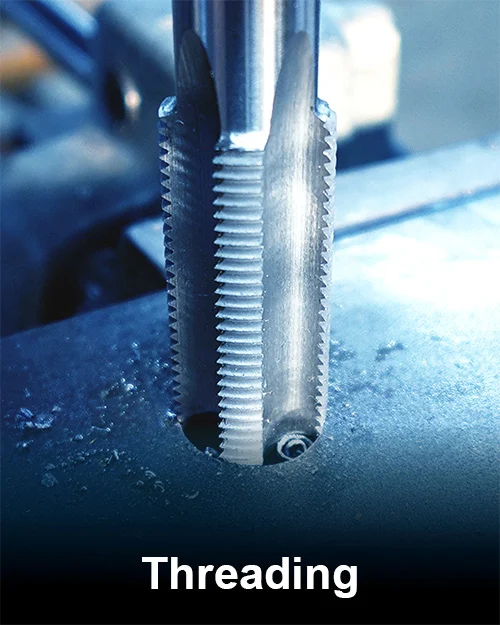
At Century Drill & Tool, our tap and die manufacturing relies on controlled vacuum heat treatment, sub-zero cryogenic stabilization, and precision CNC thread grinding using vitrified CBN wheels. This ensures that every tooth crest delivers uniform load distribution across the entire thread engagement length.

Master UNC/UNF fractional sizes machined from precision high-speed steel with protective blow-molded case.
Taps & Dies Line
Matched reverse-flute drills and aggressive spiral extractors engineered to back out frozen bolts without damaged casing.
Fastener Extraction
Patented cross-cut restoring tool designed to reform bruised external threads quickly without removing sound material.
Thread Restoration
Precision ground 60° center-drill countersink for lathe work and starter pilot hole accuracy prior to tapping operations.
Pilot DrillingThe global cutting tool market is experiencing a structural evolution driven by automation, material science innovations, and nearshoring logistics. Procurement total-cost-of-ownership (TCO) models are shifting focus from piece-price acquisition to cost-per-threaded-hole performance ratios.
With modern multi-axis CNC machining centers featuring high-speed spindle sync, rigid tapping has replaced traditional floating tap holders. This shift demands taps with tight shank concentricity and shank-to-pitch runout tolerances under 0.005 mm. Simultaneously, cold forming (roll) taps are gaining rapid market share. Roll tapping forms threads via plastic deformation rather than cutting metal, producing zero chips, increasing thread tensile strength by 15-20%, and expanding tool life up to 5 times over conventional cut taps in ductile materials.
Enterprise global buyers are increasingly relying on AI search engines, digital twin simulations, and machine learning models to manage tooling inventories. Predictive maintenance sensors integrated into CNC machines track spindle torque spikes indicating tap dullness, automatically triggering automated ERP reorders. B2B suppliers who provide standardized EDI datasets, full 3D STEP models, and transparent material certification (MTC) gain an unbeatable competitive advantage in automated vendor evaluation matrix systems.
Environmental standards (ISO 14001, REACH, RoHS) are extending directly into tool manufacturing. Industrial buyers require tool manufacturers to implement closed-loop cobalt and carbide recycling programs. Century Drill & Tool supports global partners through sustainable tool packaging options, reduced single-use plastics, and resilient multi-hub distribution node logistics that safeguard lead times against geopolitical shipping bottlenecks.
Use this technical decision matrix to select optimum tool materials, surface coatings, and geometric configurations based on workpiece material characteristics.
| Workpiece Material | Tensile Strength / Hardness | Recommended Substrate | Optimal Geometry / Tap Style | Surface Finish / Coating | Coolant Strategy |
|---|---|---|---|---|---|
| Low Carbon & Mild Steel (1018, A36) | < 650 MPa / < 20 HRC | M2 HSS | Spiral Point (Through) / 30° Spiral Flute (Blind) | Steam Oxide (Black) | Soluble Oil Emulsion (5-8%) |
| Stainless Steel (304, 316, 316L) | 750-950 MPa / 22-32 HRC | M35 Cobalt (HSS-E) | 45° High Helix Spiral Flute with Relief | TiAlN / AlCrN Coated | High-Pressure Neat Synthetic Oil |
| Alloy Steels (4140, 4340, D2) | > 1000 MPa / 30-42 HRC | Sub-Micron Solid Carbide | Straight Flute Taper Chamfer or Form Tap | TiCCN Multi-Layer | Through-Spindle High Pressure Coolant |
| Cast Iron (Gray & Ductile) | 150-350 MPa / 160-260 HB | M2 HSS or Carbide | Straight Flute with 0° Rake & Guide Chamfer | TiN / Uncoated Nitrided | Dry Tapping with Air Blast / MQL |
| Aluminum Alloys (6061-T6, 7075) | 310-570 MPa / 95-150 HB | M2 HSS / Form Tap | Cold Forming (No Flute) or 45° Polished Helix | Bright / Diamond-Like Carbon (DLC) | Kerosene or Light Synthetic Emulsion |
| Titanium & Inconel Alloys | > 1100 MPa / > 36 HRC | M35 Cobalt / Micrograin Carbide | Interrupted Thread Spiral Flute (Reduced Friction) | AlTiN / Seamless Oxide Passivated | Micro-Lubrication (MQL) with High EP |
Procurement efficiency is built on transparency, technical accuracy, and reliable supply chain execution. Century Drill & Tool integrates deep manufacturing expertise directly into B2B vendor partnerships.
In Google’s Search Quality Rater Guidelines, E-E-A-T (Experience, Expertise, Authoritativeness, and Trustworthiness) forms the foundation for evaluating digital value. Century Drill & Tool’s operational history provides authentic depth behind every technical claim.
Since 1940, our company has supplied industrial buyers, professional tradespeople, hardware cooperatives, and automotive aftermarket distributors across North America, Europe, Asia, and Latin America. We do not simply trade tooling; we design cutting edge geometry. Our engineering teams review customer wear patterns, evaluate chip formation under digital microscopy, and continually refine helix angles and chamfer reliefs.
"Quality tooling is not an expense—it is an investment in manufacturing uptime. When a thread tap cuts cleanly without binding, tool life increases, machine downtime drops to zero, and part yield reaches 100%."
— Century Drill & Tool Product Engineering Division
Direct link to specialized tooling categories engineered for industrial distribution and OEM catalog integration.
Precision ground HSS, Cobalt, and carbon thread cutting sets.
→Spiral and straight flute extractors for broken stud removal.
→M2, M35 Cobalt, and carbide drill bits with 135° split points.
→Type 1 and Type 27 abrasive cutoff and weld grinding wheels.
→Cup, wheel, and end brushes for surface rust and deburring.
→American-pattern flat, round, and Nu-Thred thread restoring files.
→Bi-metal hole saws and reciprocating saw blades for tough metal.
→Heavy-duty aviation snips, center punches, and cold chisels.
→In-depth technical guides curated for tool specifiers, shop managers, and global procurement teams.
UNC/UNF size standards, clearance hole sizing, and tapping speed recommendations.
Thread RepairTechnical analysis on metal pitch restoration vs re-tapping external threads.
Fastener RepairStep-by-step extraction procedure for frozen and sheared structural studs.
Drilling ScienceMaterial chemistry breakdown (M2 vs M35 vs M42) and point angle geometry dynamics.
Machining SetupCenter drilling specifications for CNC lathe tailstocks and machining fixtures.
Abrasive SafetyWheel bond structure, RPM safety ratings, and grain selection for stainless cutting.
Surface PrepKnotted vs crimped wire selection for weld spatter and corrosion removal.
Supply ChainOEM packaging, drop-ship fulfillment, and global distributor program support.
IndexComplete indexing of industrial tool search queries and spec sheets.
Premature tap failure in 316 stainless steel is primarily driven by work-hardening, poor chip evacuation, and thermal friction. Specifying M35 Cobalt (HSS-E) or Solid Carbide taps with a 45° high-helix angle, optimized rake angles (12°-15°), and TiAlN coatings dramatically reduces friction and prevents chip re-cutting, extending tool life up to 320%.
Spiral Point (Gun) taps push chips forward ahead of the cutting edge, making them ideal for through-hole threading with maximum rigid shank strength. Spiral Flute taps pull chips upward out of the hole like a twist drill, preventing chip packing in blind-hole tapping applications.
H-limits (Imperial) and D-limits (Metric) define the oversize increment above the basic pitch diameter in 0.0005-inch increments. Selecting correct limits (e.g., H3 vs H5) ensures class 2B or 3B thread fit compliance while accounting for material elastic recovery and post-heat-treatment plating thickness.
Procurement teams should require Mill Test Certificates (MTC) verifying raw material chemical composition (M2, M35, M42 steel), ISO 9001:2015 quality management compliance, Rockwell C Hardness (HRC 64-67) inspection reports, and Certificate of Conformance (CoC) for thread profile accuracy (ISO 68-1 / ASME B1.13M).
Cold forming (roll tapping) is preferred for ductile materials (aluminum, brass, mild steel, austenitic stainless) with at least 10% elongation. Roll tapping eliminates swarf/chips entirely, increases thread tensile strength by 15-20% through grain flow realignment, and allows up to 2-3x higher tapping speeds.
Access our complete 2025 product engineering catalog, request custom OEM private-label pricing, or consult directly with our technical support team today.